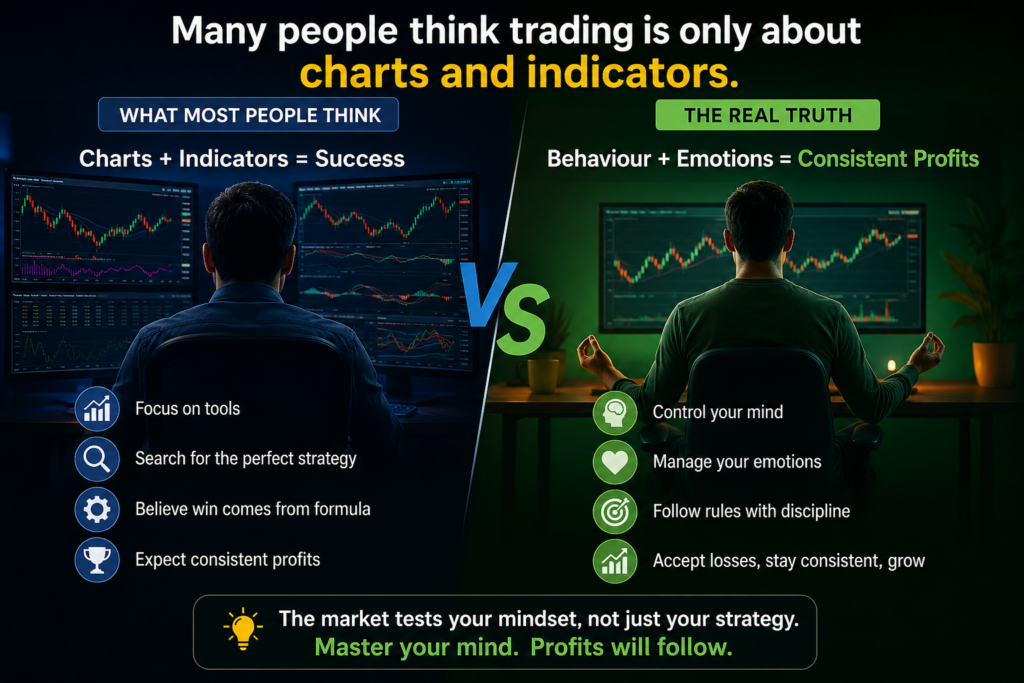
Many people think trading is only about charts and indicators.
But the truth is—your behaviour and emotions matter more than your strategy.
Today, starting trading in STOCK MARKET currency, commodity, Derivatives is easier than ever.
You don’t need an office, a shop, or any special license.
All you need is a mobile phone, internet connection, Pan card and a Demat account.
The best part? A Demat account can be opened in just a few minutes, and you can start trading within 24 hours.
After opening a trading account, you don’t need any degree, course, or formal training to start trading. If you can use apps like Facebook or Instagram, you can easily learn how to buy and sell shares on a trading app, this is that much simple. However, there is a big difference between starting trading and making profits.
This is what attracts most of the people to start trading in the share market, as it looks very cool and comfortable to just tap a buy and sell button on your laptop or mobile and start earning. But the reality is totally different. There is a saying about trading in the stock market that, “it is the easiest money but hardest to earn.
But we are not here to talk about what kind of skills, mindset, or software is needed to get consistent profit from the share market. We are here to understand how Human Behaviour Affects Trading Psychology.
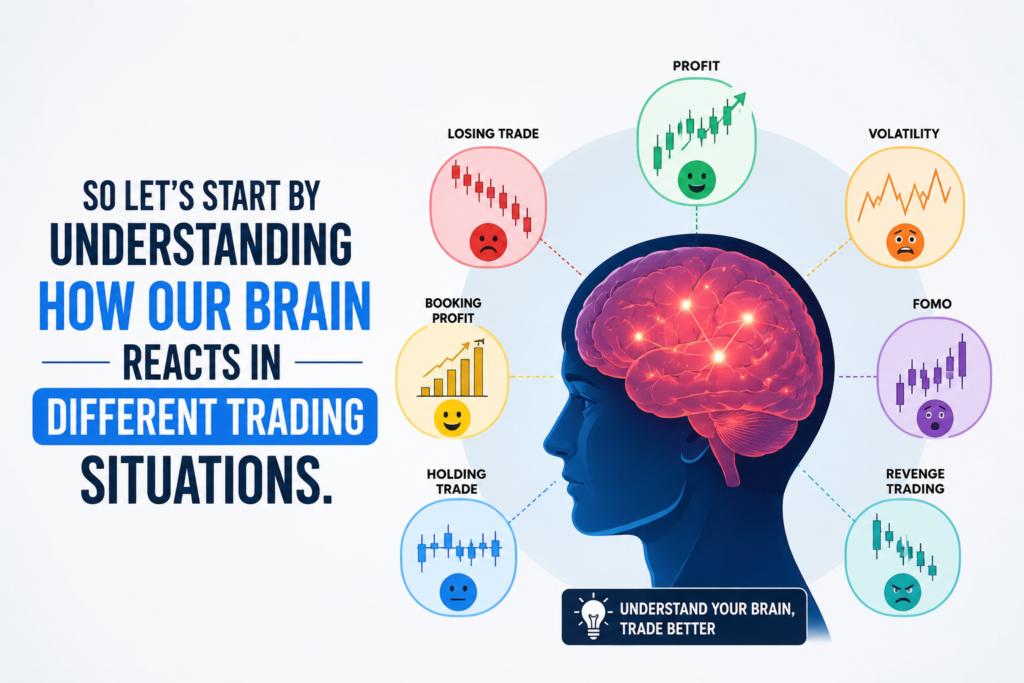
So let’s start by understanding how our Brain reacts in different trading situations.
Patience
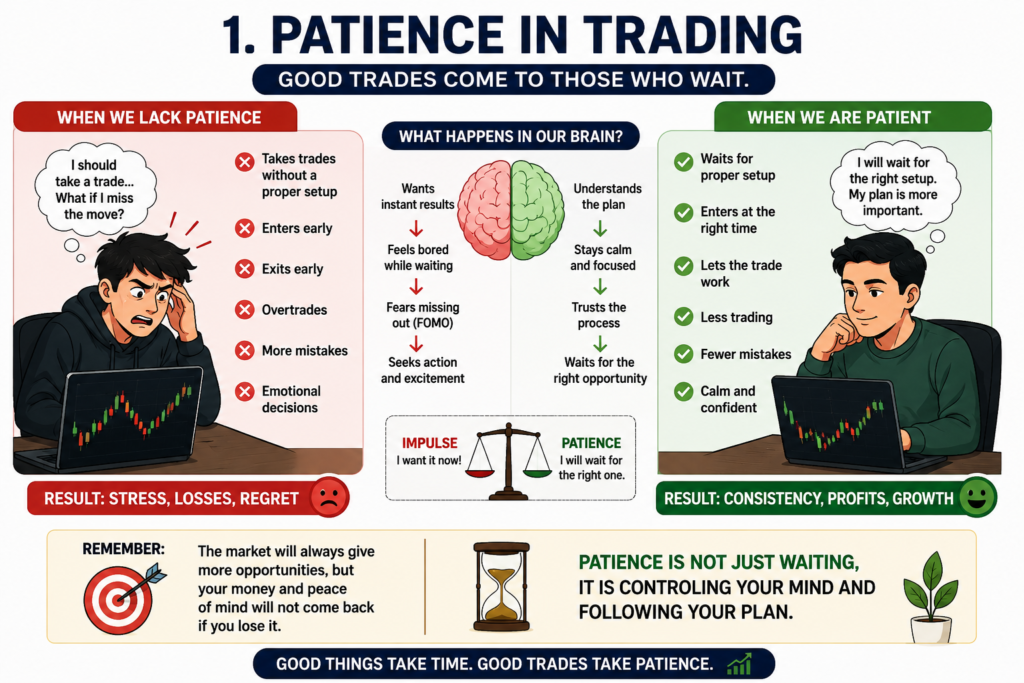
In trading, patience is very important, but our brain does not like to wait. When we sit in front of the screen, our mind always wants some action. Even if there is no good opportunity, the brain pushes us to take trades just to feel active.
This happens because our brain wants quick results and fast profits. In real life also, we like things fast, and the same behaviour comes into trading. Because of this, traders enter trades early, exit trades early, or take unnecessary trades.
In trading, patience means waiting for the right setup and following your plan. But our mind creates pressure like “what if I miss this move?” or “let me just take this trade.”
So, patience in trading is not just about waiting, it is about controlling your mind and not reacting to every small market move.
Fear
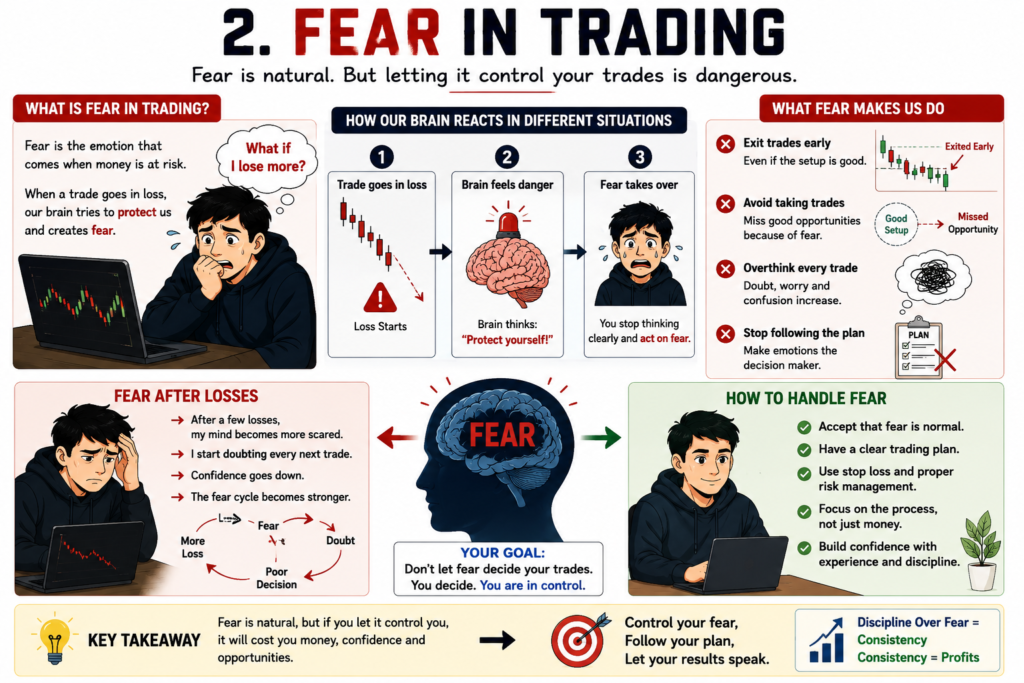
Fear is one of the most common emotions in trading. It mainly comes when money is at risk. When a trade starts going in loss, our brain immediately tries to protect us and creates fear.
Because of this fear, traders exit trades early, even if the setup is still good.
Our brain is designed to avoid pain, and in trading, loss feels like pain. So instead of following the plan, we make decisions based on fear.
Fear also comes after a loss. Once a trader faces a few losses, the mind becomes more scared and starts doubting every next trade to recover losses rapidly, and when we take trades in this mindset we ignore our trading setup and starts taking random trades which only increase our losses and our trading costs (brokerage and other charges).
Fear is not only triggered when a trade is in loss, it can also come when a trade is in profit. This is called the fear of losing profit.
When a trade is going in our favor and starts showing profit, everything feels good. But if the price pulls back a little, our mind starts fearing that the profit will reduce or disappear. Because of this, we exit the trade early.
As a result, we book small profits and let losses become bigger. This creates a situation where even after finding good trades and having good analysis, we still remain in overall loss.
fear in profit is also dangerous, because it does not allow winning trades to grow properly.
So, fear in trading is natural, but if we let it control our decisions, it stops us from taking the right trades and affects our overall performance.
HOPE
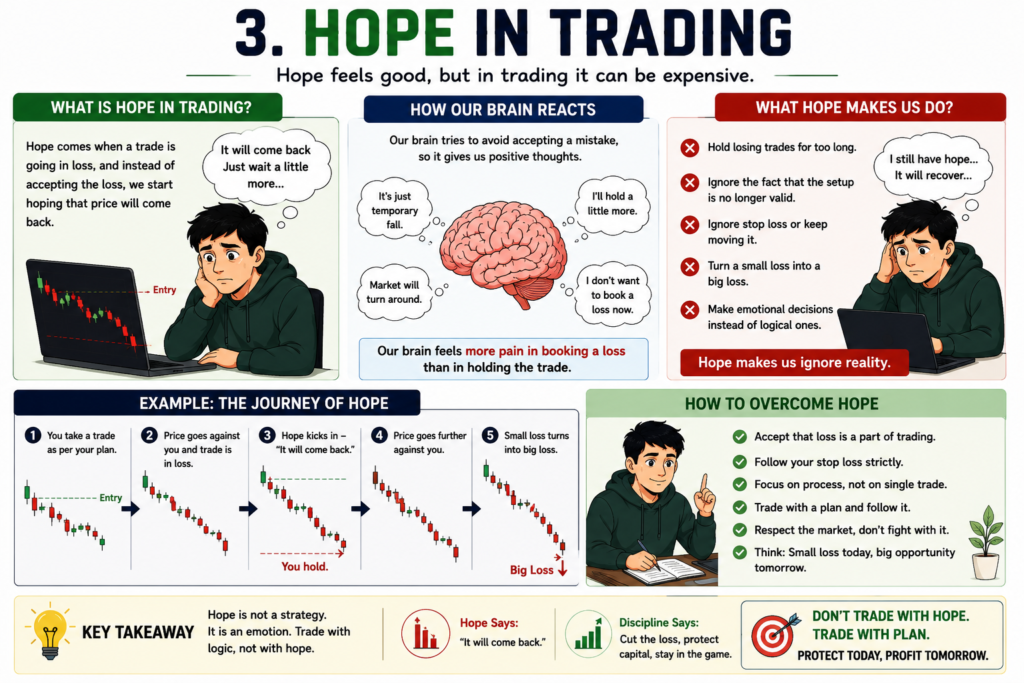
Hope is another strong emotion in trading. It mostly comes when a trade is going in loss, but instead of accepting the loss, we start hoping that the price will come back.
Our brain tries to avoid accepting a mistake, so it keeps giving us positive thoughts like “it will recover” or “just wait a little more.” Because of this, traders hold losing trades for too long. (due to which capital is stuck or have to book a big loss instead of small loss)
In trading, hope makes us ignore reality. Even when the setup is no longer valid, we stay in the trade just because we don’t want to book a loss.
This happens because our brain feels more pain in booking a loss than in holding it. So instead of taking a small loss, we keep hoping and sometimes it turns into a big loss.
hope in trading can be dangerous if not controlled, because it stops us from taking the right exit at the right time. So, always follow Stoploss, always follow Trading Setup
GREED
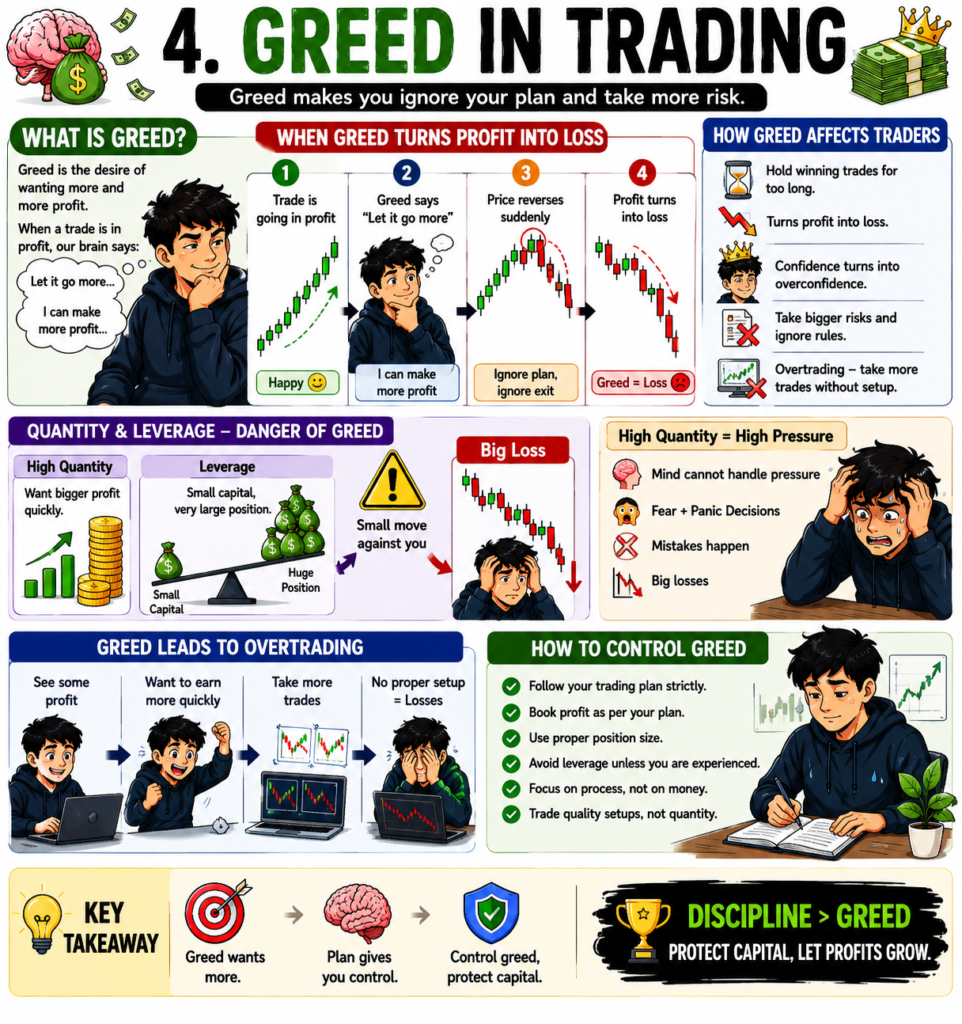
Greed is the emotion of wanting more and more profit in trading. When a trade is going in profit, instead of booking it as per the plan, our brain starts thinking “let it go more” or “I can make more profit.”
Because of this, traders hold winning trades for too long and sometimes the profit turns into loss.
Our brain always wants maximum gain, and this creates greed. After getting some profit, confidence increases and slowly it turns into overconfidence. Then traders start taking bigger risks and ignore their rules.
Greed also makes traders overtrade. When they see profit, they want to earn more quickly, so they take more trades without proper setup.
Another important aspect is quantity control. Due to greed, traders often take high quantity trades to make bigger profits quickly. Leverage makes this even easier, because it allows traders to take very large positions with a small amount of capital. While this can increase profits, it also increases risk significantly. Even a small unfavorable move can create large losses when leverage is used.
When the quantity is too high, our mind is not able to handle such pressure, which leads to panic decisions and mistakes.
So, greed in trading can be dangerous because it makes us ignore our plan, take higher risks than we can handle, and make decisions based on emotions instead of logic.
FOMO
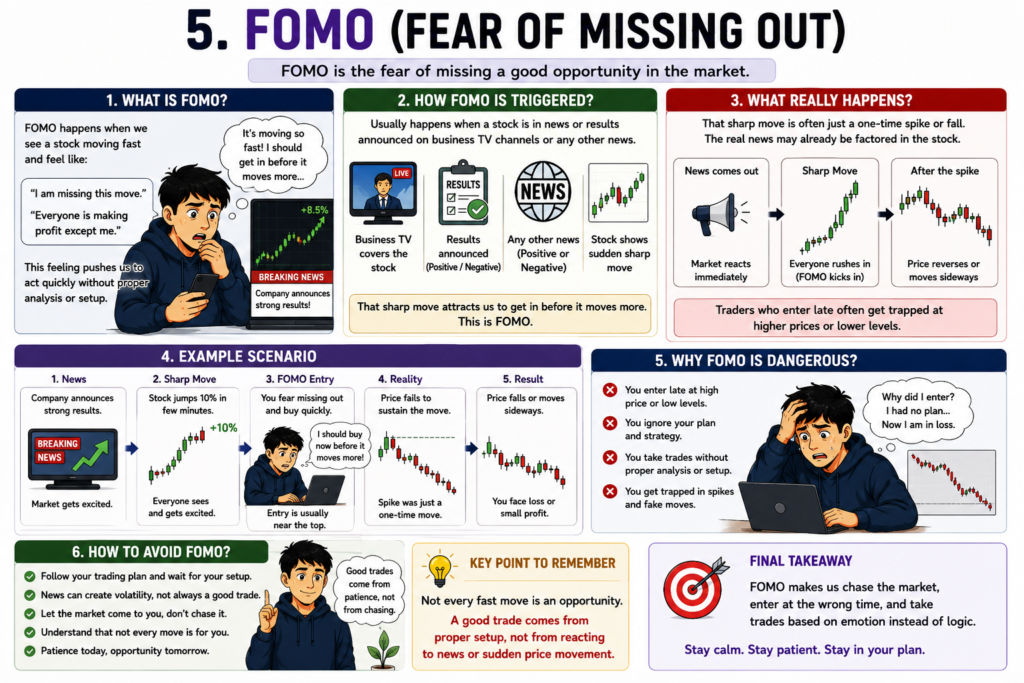
FOMO is the fear of missing a good opportunity in the market. It happens when we see a stock moving fast and feel like “I am missing this move” or “everyone is making profit except me.”
Because of this, traders enter trades late, without proper analysis or setup. Most of the time, they buy when the move is already done and risk is high.
Our brain does not like to feel left out. When we see others making profit or a stock moving strongly, it creates pressure to act quickly. This leads to impulsive decisions instead of planned trades.
FOMO also makes traders ignore their strategy. They jump into trades just because the market is moving, not because it fits their setup.
This usually happens when a stock is in the news, such as during result announcements, business TV coverage, or any positive or negative news. Because of this news, the stock often shows a sharp move in one direction.
That sudden move attracts traders, and they feel like entering the stock quickly before it moves even more. This is where FOMO starts.
But in reality, many times this sharp move is just a one-time spike or fall. The market may have already factored in the news, and the price has already reacted to it.
As a result, traders who enter late often get trapped at higher prices or lower levels, and the stock may reverse or move sideways after that.
So, instead of chasing such moves, it is important to understand that not every fast move is an opportunity. A good trade comes from proper setup, not from reacting to news or sudden price movement.
So, FOMO in trading is dangerous because it makes us chase the market, enter at the wrong time, and take trades based on emotion instead of logic.
RECENCY BIAS
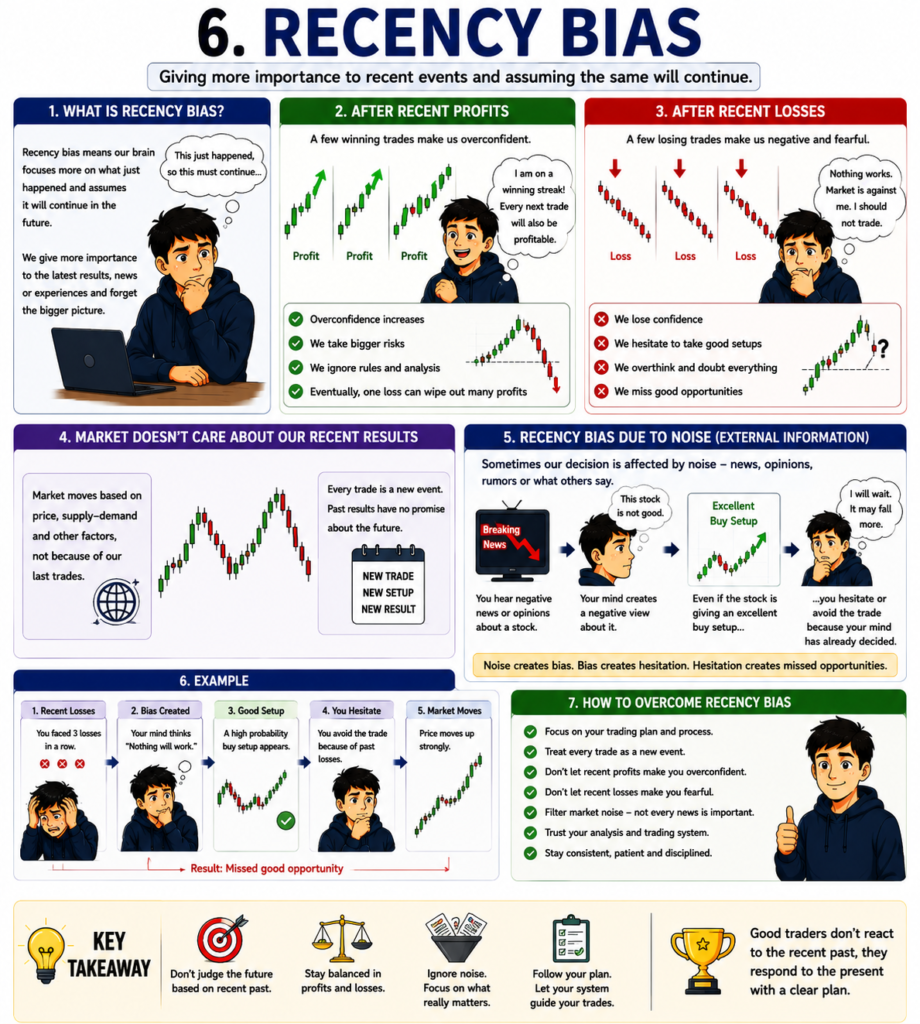
Recency bias means giving more importance to recent trades or recent market movements. Our brain remembers what just happened and assumes the same will continue in the future.
For example, if a trader gets a few continuous profits, they start feeling confident and think that every next trade will also be profitable. Because of this, they may take bigger risks or ignore proper analysis.
On the other hand, if a trader faces a few losses, the mind becomes negative and starts thinking that nothing will work. This creates fear and hesitation in taking the next trade, even if it is a good setup.
In trading, the market does not move based on our last trades. Every trade is different, but our brain keeps connecting it with recent results.
Sometimes this also happens because of market noise. For example, if you hear negative news or opinions about a particular stock, your mind starts forming a negative view about it.
Because of this, even if that stock is showing a good buying setup, you may hesitate to take the trade. This happens because your brain has already made a decision based on recent information or external opinions.
In trading, not all news or opinions are important, but our brain gives them more importance than required. This affects our judgment and stops us from taking good opportunities.
So, it is important to understand that market noise can influence our thinking. A good trader focuses on their own analysis and setup, instead of reacting to every news or opinion.
So, recency bias is dangerous because it makes us overconfident after profits and fearful after losses, instead of following a consistent plan.
Rationalism
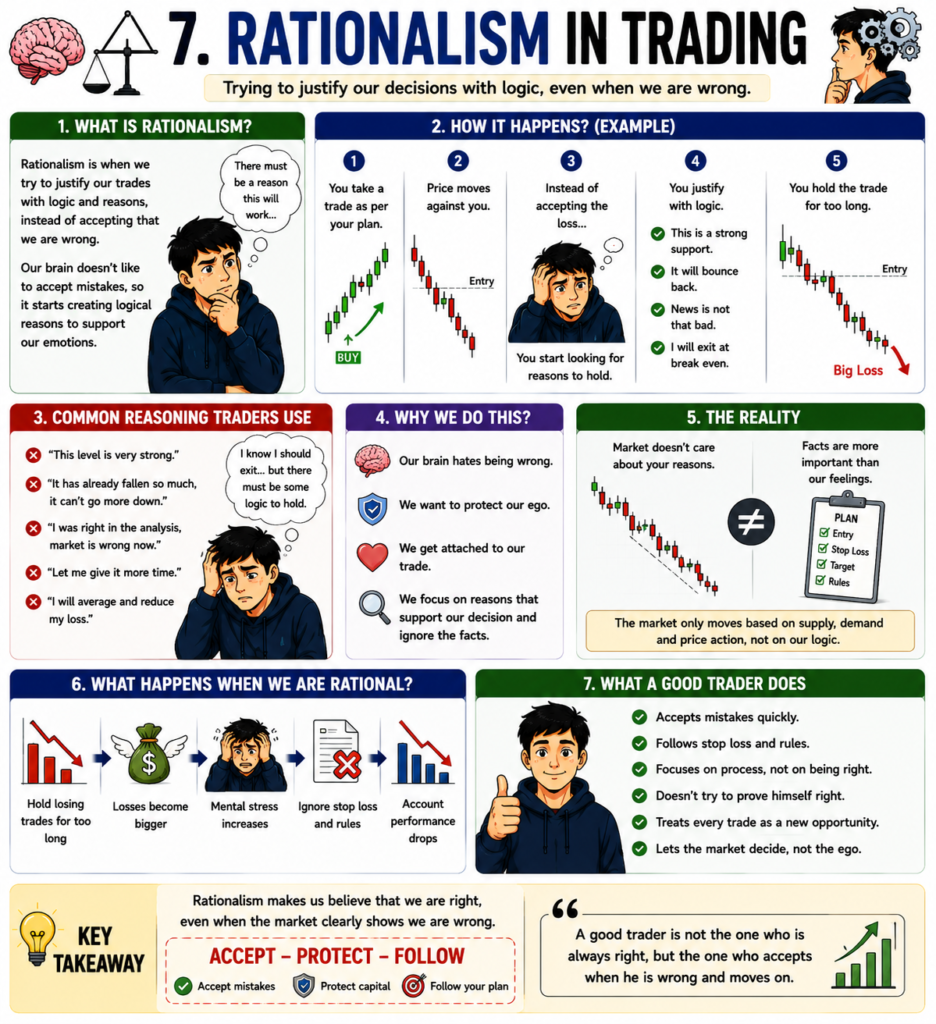
Rationalism in trading means trying to justify our decisions using logic, even when they are wrong. Instead of accepting a mistake, our brain starts giving reasons to support our trade.
For example, when a trade goes in loss, instead of exiting as per plan, we start thinking “this level is strong,” or “it will bounce back from here.” In this way, we try to prove that our decision is still right.
Our brain does not like to accept that we are wrong, so it creates logical reasons to support our emotions. Because of this, traders hold losing trades for too long or ignore their stop loss.
Sometimes, traders also change their strategy again and again just to justify their previous decisions.
So, rationalism in trading is dangerous because it makes us believe that we are right, even when the market is clearly showing that we are wrong. A good trader accepts mistakes quickly and follows the plan instead of trying to prove themselves right.
HINDSIGHT BIAS
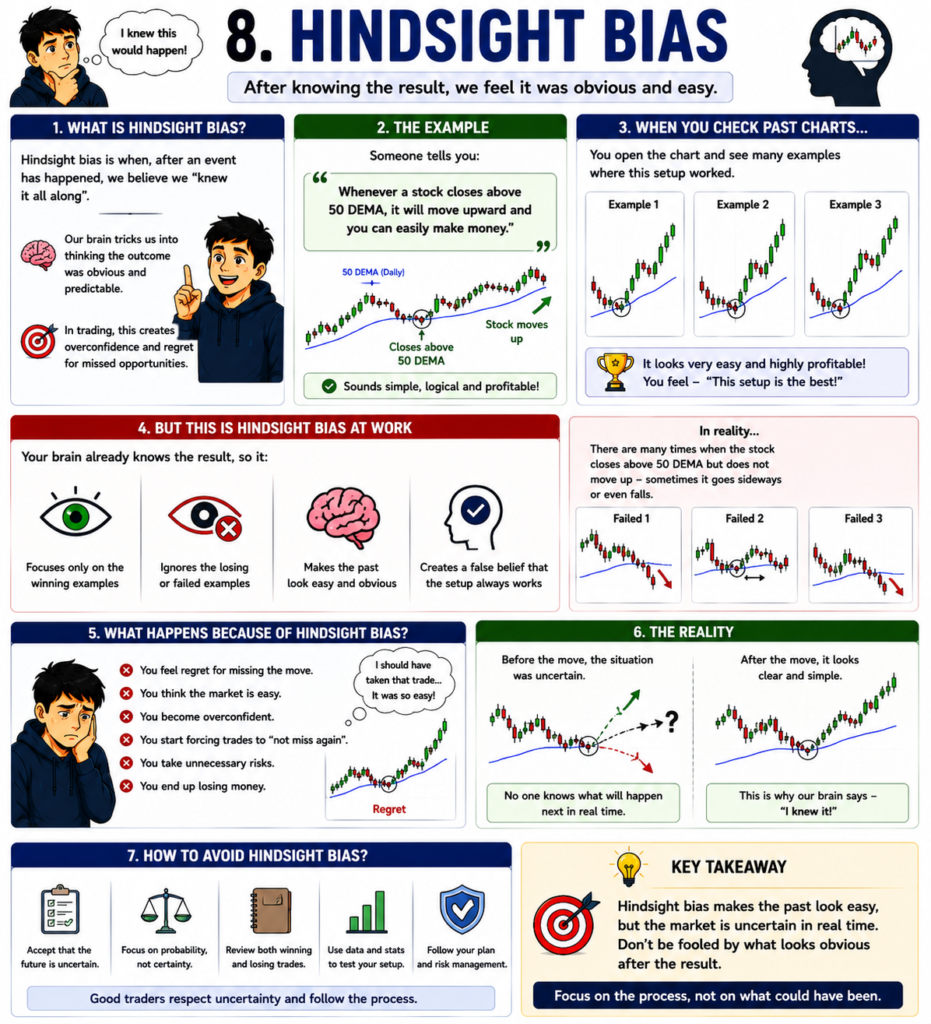
Hindsight bias means thinking that “I already knew this would happen” after the trade or market move is over.
In trading, after seeing a move, our brain makes it look very easy and obvious. We start thinking that we could have easily taken that trade and made profit.
Because of this, traders feel regret and sometimes blame themselves for missing the opportunity. This creates overconfidence and pressure to catch the next move.
But in reality, before the move happened, the situation was not that clear. The market always looks simple after the result, but it is uncertain in real time.
For example, if someone tells you that whenever a stock closes above the 50 DMA, it will move upward and you can easily make money, it sounds very simple and attractive.
If you go back and check past charts, you will easily find many examples where this setup worked. It will look very easy and highly profitable.
But this is where hindsight bias comes into play. Your brain already knows the result, so it highlights only those cases where the setup worked and ignores the situations where it failed.
In real-time trading, things are not so clear. There are many times when the stock closes above the 50 DMA but does not move upward or even falls. But our mind ignores these cases because they do not match our belief.
This creates a false confidence that the setup is perfect and always works.
Hindsight bias can be dangerous because it makes us overconfident and pushes us to take unnecessary trades just to prove ourselves right.
So, a good trader understands that the market is always uncertain and focuses on following the process, not on what could have happened.
REVENGE TRADING
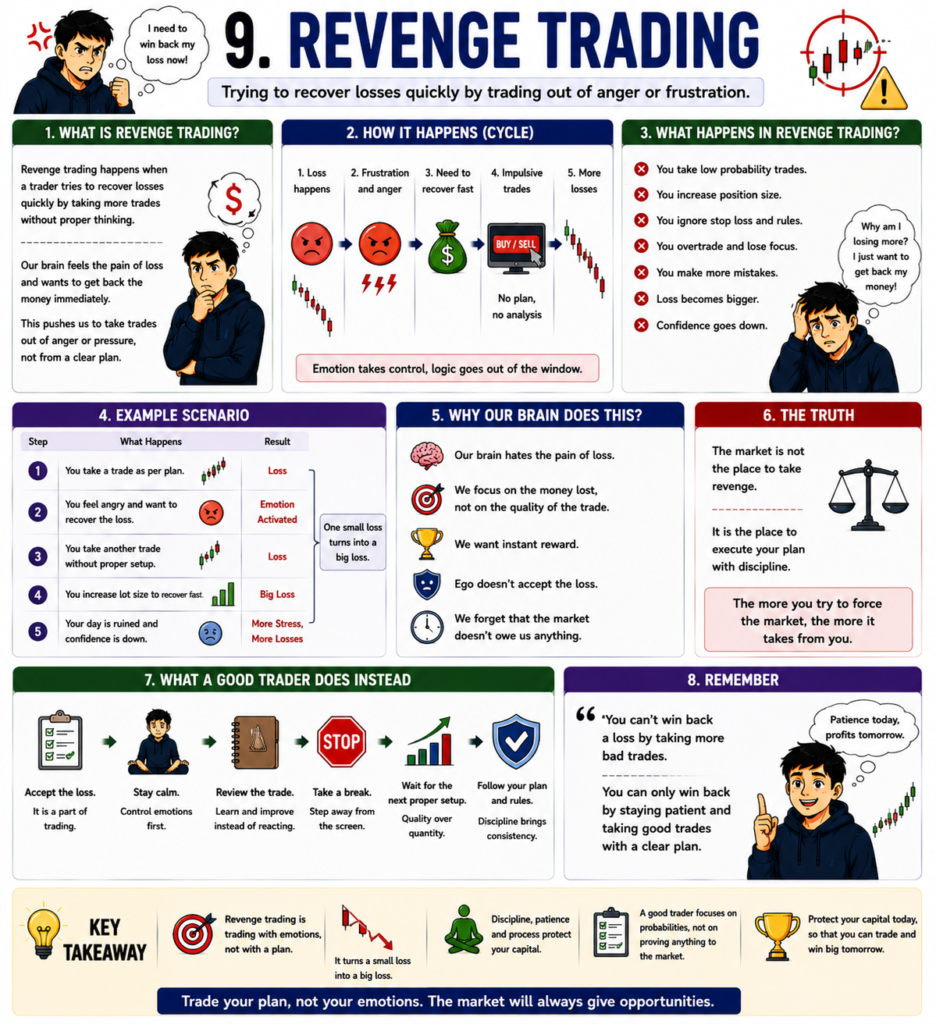
Revenge trading happens when a trader tries to recover losses quickly by taking more trades without proper thinking.
After a loss, our brain feels frustrated and wants to recover that money as soon as possible. Because of this, traders start taking trades out of anger or pressure, instead of following their plan.
In this situation, the focus shifts from making good trades to just recovering the loss. This leads to impulsive decisions, bigger risks, and more mistakes.
Most of the time, revenge trading results in even bigger losses, because the decisions are based on emotions, not logic.
Our brain tries to take control and “win back” the money, but the market does not work like that.
So, revenge trading is dangerous because it turns one small loss into a big loss. A good trader accepts the loss, stays calm, and waits for the next proper opportunity instead of reacting emotionally.
……………………………………………………………………………………………………………………THANK YOU……………………………………………………………………………………………………………………………………..